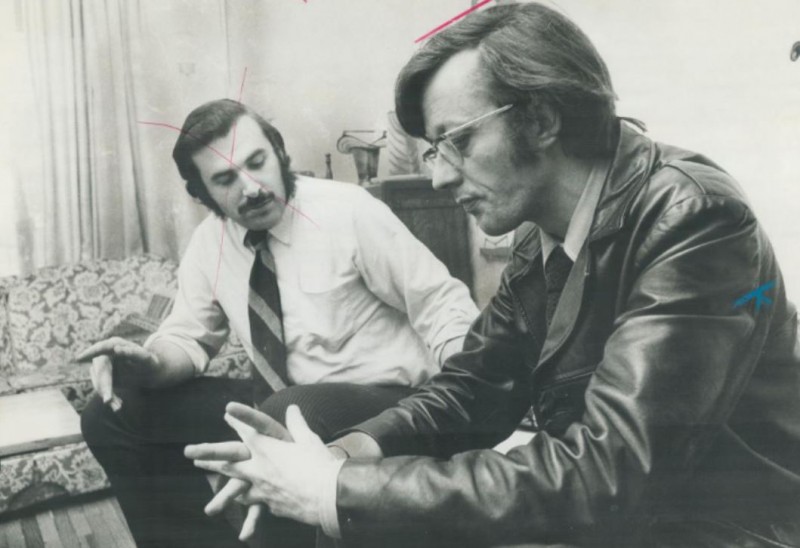
A large number of friends, family, political comrades, NDP party members, and the odd journalist were gathering at the home of Robert and Edna Laxer in Toronto in the spring of 1971.
They included future Toronto city councilor and federal NDP MP Dan Heap, fellow Wafflers Mel Watkins, Kelly Crichton and Jackie Larkin, publisher and elected Manitoba provincial NDP politician Cy Gonick, novelist and Canadian cultural nationalist David Godfrey and Toronto Star reporter/columnist Rosemary Spiers.
It was taking place after Robert and Edna’s 29-year-old-son James Laxer had managed to achieve a surprising second place finish as the candidate for the Waffle on April 24 at a polarized federal New Democratic Party leadership convention in Ottawa. It had gone four ballots before party establishment favourite, David Lewis finally came out on top on April 24.
Robert and Edna Laxer all sounded hopeful about the future of the Waffle. It appeared that their movement which was a caucus inside the NDP had a fighting chance to influence the party and push it forward in a bolder and more left-wing direction of an independent socialist Canada that was less dominated economically and culturally by the U.S. (An issue that still resonates today).
But the emergence of such a movement with new radical ideas also made it a target. What almost everybody else at the gathering of the Laxer party here did not realize is that one of their guests in this trusted circle was in fact an undercover agent for the RCMP Security Service.
The anonymous agent in his 17-page memo to RCMP handlers talked about “associating” with the Laxer family over a four-month period starting in March in 1971.
This was one of many memos that I found amidst the hundreds of pages of RCMP files on Waffle which are now publicly available at Library and Archives web site following a request for the material by another researcher under the federal access to information legislation.
The purpose of a security and intelligence operation like the Security Service is not to help lay a criminal charge. Its prime function is to gather sensitive information on a perceived national security threat that is supposed to assist those in power in Ottawa to make political decisions involving public safety. A key function of the undercover agent is to follow key players, patterns in the decision-making and potential conflicts with allies and opponents. The issue is whether the Security Service (or its successor in today’s Canadian Security and Intelligence Service) wastes public dollars collecting intelligence on people or groups that are not serious threats.
The RCMP agent whom I was reading was one of an unknown number of agents or “sources” assigned by the Security Service to infiltrate and become active participants in the Waffle. They were expected to report in great detail and seamlessly on the inner workings on the Waffle. This included attending both its internal meetings and larger NDP party sessions. The agent would get to know, intimately, the key players such as the members of the Laxer family which is what the author of the 17-page memo managed to do.
We learn a great deal (perhaps too much) about Robert and Edna’s personal affairs and private investments. Edna apparently owned 50 shares of Hiram Walker as well as some Domtar (not clear how much). Plus, Robert and Edna purchased a cottage at Sunny Lake near Gravenhurst in Ontario which would remain with the family for years.
“According to Edna,” wrote the undercover agent “this land purchase is really straining their finances as they lost some money on Jim’s book (title unknown) which may or may not be recovered.”
This was a reference to James Laxer’s, The Energy Poker Game: The Politics of the Continental Resources Deal, the first of many books in his career as a political commentator.
She anguishes that her and her husband’s financial investment in the Waffle, including long distance phone calls that members of the group were doing. We are “always losing money on the Waffle,” she stated.
The memo curiously mentions Edna’s decision to get her drivers license in middle age even as she was uncomfortable being behind the wheel of the family large station wagon.
More structurally, in an attempt to understand how the Waffle functioned, the agent observed “that Robert and Enda are very involved with the Waffle movement and spend many hours doing the background organizational work for the Waffle. They frequently consult with Jim to discuss Waffle matters.”
Also, Edna “has been busy getting their membership lists up to date,” the agent continues.
James Laxer was by then a university instructor but relied on his father to gain greater access to a valuable constituency in labour that was out of his reach for the Waffle. Many of its adherents came out of the university environment.
“Bob appears to be the main Waffle contact with trade unionist people who seem to value his opinion. Bob is very intent on building a strong Waffle labour following and spares no energy in this regard. Jim supports him in this effort but leaves most of the spade work to his father while Jim does the formal speaking to various labour groups,” the agent wrote.
This did not bear fruit as had been hoped. The Waffle ‘s support for independent Canadian unions and workers control came into conflict with the traditional US based international private sector unions like the United Auto Workers and the United Steelworkers which played a role in having the movement ultimately expelled from the party.
Meanwhile, here is an example where the agent referred to himself in the third person:
“Source describes Jim (James Laxer) as a very intelligent, soft spoken personable man who is very strong willed but willing to listen to other views but is not necessarily swayed by them,” the agent observed.
Robert was a clinical psychologist who taught at the Ontario Institute for Studies in Education (OISIE) in Toronto.
His other son Gord had returned from England to take part in James’ leadership candidacy. He strongly denies the characterization by the unknown RCMP agent in the pages about the gathering at the Laxer residence that he had difficulty finding work or considered going on welfare.
Why so much interest in the Laxer family? Robert and Edna Laxer were active members of the Communist Party of Canada (CPC) until 1956 when they quit along with others out of disgust with the fresh revelations of the murderous nature of Soviet Union dictator Joseph Stalin who had since passed away.
But their switch to the Waffle style democratic socialism focused on public ownership as a tool for Canadian independence still did not endear them to the Mounties.
Both current and former CPC members were regarded along with the Trotskyist League for Socialist Action as “subversive elements,” attempting to gain respectability by penetrating the NDP via the Waffle, according to a public 1977 statement by Ontario Attorney General Roy McMurtry. Furthermore, the Security Service lost interest in the Waffle after its expulsion from the Ontario wing of the NDP in June 1972.
(By operating outside its natural political space of the NDP the Waffle had difficulty continuing, closing its doors by 1975.)
The McMurtry announcement is revealed in a 2012 book co-authored by Reg Whitaker, Gregory Kealy and Andrew Parnaby in their 2012 book, Secret Service: Political Policing in Canada from the Fenians to Fortress America.
Judging from the RCMP files there seemed to be an element of once a Communist always a Communist at the Security Service even if the person in question had left the party behind. Plus, this suspicion extended to Robert and Edna’s sons James and Gordon who were red diaper babies too boot. The two had been active in student anti-war politics at the University of Toronto during the 1960s as well as engaged in early discussions about Canadian nationalism and the place of Quebec in the confederation.
There was little understanding at the Security Service about the generational differences between the old authoritarian Left in the CPC and a more democratic grassroots New Left that the two Laxer brothers had represented.
Whitaker, an emeritus professor in history at the University of Victoria. was himself a young person drawn to the Waffle in the early 70s. He was living in Toronto and had visited the Laxer family residence, although not the time described in the 17-page RCMP agent’s memo.
“I was certainly not part of any inner circle in the Waffle or the NDP. My wife and I used to regularly go up to the Laxers’ address,” said Whitaker.
“I did certainly meet some of the people that are mentioned,” Whitaker remarks about the guests listed in the 17-page RCMP memo. He expressed surprise at the level of detail about Robert and Edna including what stocks they purchased for investment purposes. “Who was this person,” he asked. It was hard to say even after studying the guest list, he added.
Let us get back to the Laxer family gathering. One surprise guest at the Laxer residence was Zena Cherry, the high profile and much read Globe and Mail gossip columnist back then.
Cherry arrived eager for more details about the impending wedding of two Waffle stalwarts, Mel Watkins (University of Toronto political economy professor) and Kelly Crichton (a television journalist.) Later in we learned that Robert and Edna served as character witnesses in a custody hearing during Mel’s divorce proceedings. The agent doesn’t elaborate further but Crichton explained more recently to me in an interview that Mel was trying to gain custody of his young son from his first troubled marriage with a woman with significant mental health issues including suicide attempts. (something that was rarely discussed in the 1970s)
Crichton added that courts in that time period rarely heard applications from men seeking custody of their child. That was the reason why the judge in the case insisted that Mel and Kelly marry formally to regularize their relationship which they did. “The media did not cover that. Thank God because they could have,” she related.
Also showing up at the gathering was the Regina based couple Lorne and Caroline Brown who were active in the Saskatchewan Waffle. The agent has nothing to say about the couple. But their presence at the gathering of the Laxer family was rather ironic considering that two years later in 1974, their joint historical non-fiction book, An Unauthorized History of the RCMP was published.
The RCMP “source,” at the Laxer family gathering was noticeably caught off guard by the new feminism in this period of the 1970s. (The RCMP was largely male and I suspect this informant was too)
He noted with some surprise that Krista Maeots, James Laxer’s wife, preferred to maintain her maiden name rather than adopt the last name of her husband. (There is a similar reaction by the Security Service to other women in the Waffle including Kelly Crichton and Jackie Larken who kept their original names.)
The author of the 17-page memo also reported that James and Krista had “one of those modern marriages where housework and child rearing are shared duties while each parent pursues a career.”
One lingering question is how the RCMP agent managed to obtain a complete guest list at the Laxer gathering from Robert and Edna Laxer.
We will never know. Meanwhile, the source for the 17-page memo was congratulated for having done a fine job with this “exceptionally fine comprehensive and informative report,” by H.P. Tadeson, a senior Security Service officer.
Looking at the RCMP files, it appears that the RCMP surveillance of the Waffle began at the 1969 Winnipeg federal NDP convention where a motion in support of the Waffle manifesto introduced by James Laxer and Mel Watkins was defeated by a slim margin — 499 against versus 268 votes in favour.
The Waffle emerged from the “extreme left,” of the NDP, wrote RCMP Security constable R.W. McMartin in an internal Oct. 23, 1970 Security Service memo.
The strong language should be placed in context. The Security Service viewed the entire left from moderate social democrats in the NDP to the pro-Soviet CP and the hardline Maoists CP-ML as one and the same under the Cold War. There was a large RCMP Security Service file, for instance, on Tommy Douglas, former NDP leader (prior to David Lewis) and premier of Saskatchewan that journalists spent years attempting to fully access.
Another pivotal event in the history of the Waffle was as mentioned: the 1971 NDP federal leadership convention.
Here is how Security Service officer J.R. Murphy described the RCMP Security operation inside the 1971 NDP federal leadership convention.
“The entire [NDP] convention was well covered by our sources in particular the information supplied in paragraph one is very concise and provides us with much needed insight into the workings of the Waffle,” whispered Murphy
The Security Service was fascinated by the charisma and popularity of Mel Watkins who was somewhat older than his colleagues inside the Waffle.
He taught political economy at the University of Toronto and was the former chair of a federal government task force on foreign ownership in the Canadian economy. After his recommendations were ignored by the Liberal government headed by Prime Minister Lester Pearson, Watkins moved left towards the NDP where he worked closely with James Laxer on the writing of the Waffle manifesto.
“Mel Watkins appears to be the person who controls the emotional barometer of the Waffle Group. When he thinks they win a point [during debates at an NDP convention] the Waffle become very aggressive and when he thinks sweet reasonableness will win a point then they are all sweet reason. He leads rather like a conductor in orchestra,” wrote an unidentified RCMP agent or officer.
I also shared the RCMP agent’s 17 pager with Gordon Laxer who had been the first chair of the Toronto Waffle.
“Did we know we had spies in our midst [in the Waffle]? Yes, we did. The Mounties were pretty clunky [with their technology],” says Gordon. He is today retired in his early 80s after teaching political economics at the University of Alberta. He was also the founder of the progressive Parkland Institute.
Gordon recalls how his brother James would typically pick up the telephone to make a call and hear unusual noises for a few seconds on the line. “He figured his phone was bugged.”
He is scathing about the RCMP’s intrusion into his family’s affairs.
“What a waste of taxpayers’ money to pay spies to record such trivia about the minutiae of boring, harmless people’s lives like mine and my mom’s. The Mounties have always been stupid – not able to discern the difference between really dangerous people and non-violent actors like Wafflers who did everything above board.”
Gord Laxer explains that the Waffle did not actively seek out to identify spies in its midst because such searches would have made everyone in the group “paranoid” and unwelcoming to new people looking to get involved.
The Waffle did not have an official membership list. Anybody could have joined but there was a preference for NDP members.
Also, the gathering at the Laxer’s in 1971 may have included family members or friends who may not have been supporters of the Waffle.
“But the spy filed their names anyway. This was very irresponsible to those mentioned,” said Gord.
Gordon Laxer says it may be possible today for him to identify the spies from the time of the Waffle but he doubts if it is worth the effort.
“The spies must have played central roles in the movement or else they would have been suspected by us. I have a few hunches of who the spy or spies might have been. But does figuring out who they were serve much purpose, besides being a fun mystery,” he added.
One name on the Mounties suspect list was a Waffle activist Gil Levine who today after his untimely death in 2009 remains a revered figure in the Canadian Union of Public Employees (CUPE). As CUPE’s research director, he developed and built the union’s research capacity for the collection bargaining process with employers
Some question marks were raised by the RCMP’s McMartin in his October 23, 1971 memo about Levine who was on the steering committee in the Waffle that voted to have James Laxer run in the 1971 leadership contest.
McMartin pointed to Levine’s membership in the Labour Progressive Party (LPP) during the early 1950s. The implication by the Mounties was that the LPP was the Communist Party of Canada under a new name.
But that was a mistaken impression, stated Ian McKay McMaster University professor emeritus of history and an expert on the Canadian left.
“The LPP was and wasn’t the CPC rebranded. Lots of middle-class people gravitated to it in the early 1950s because they were in favour of peace,” he said.
The peace movement had gone “mainstream” with the advent of the LPP in the post World War II period, continues McKay.
This was a period when there was a genuine fear of nuclear war between the US and the USSR.
“The LPP message had changed the communist movement to become much more centrist — and lots of those folks [would] wind up in the Liberal Party, not the NDP, when the bubble burst in 1956,” added McKay.
The RCMP’s McMartin portrayed Waffle activist Gil Levine as a puppet master “exerting influence” on James Laxer. “[Jim] Laxer confides in Gil Levine,” [and] may almost be considered a close associate of Levine’s,” McMartin says. In addition, “Laxer was invited by Levine to his residence to meet with [historian] Stanley Ryerson, a prominent CP of C member.”
What all of these meetings and encounters meant in the final analysis is hard to say. Gil Levine sounded like a smart man but his role in the Waffle was relatively minor, according to David Blocker’s new book on the Waffle, The New Left in Canadian Politics; The Waffle Movement and the NDP, 1965-75.
Mel Watkins’s friendship with a political philosopher C.B. MacPherson (author of the classic text The Real World of Democracy) caught the attention of the Security Service.
“Watkins has had a continuing association with C.B. MacPherson both on a professional basis and a social level. In March 1969, MacPherson was invited by Watkins to meet a Washington correspondent with [the left of centre UK magazine] New Statesman at his residence. The correspondent was interested in meeting some “interesting people,” wrote RCMP officer J.R. Murphy, in an April 3, memo laced with innuendo.
Ian McKay is currently writing a biography of C.B. MacPherson. This is his reply: “Macpherson was not a member of the Communist Party of Canada. He was aligned with but not a member of the CCF in the 1930s but he was friendly with a good many Communists — Jim Watts, Stanley Ryerson, etc. I imagine the RCMP was suspicious of him,” said Ian McKay.
Steve Hewitt, a Canadian author of many books about national security and surveillance has his own thoughts about how the undercover agents from the RCMP Security Service wrote down their findings.
“I assume that they would have written down notes from memory in the aftermath of whatever it was that they were reporting on. If there are verbatim transcripts that to me would be a sign that technology has been used to record whatever is being reported on,” said Hewitt.
Hewitt is the author of the 2010 book, Snitch! A History of the Modern Intelligence Informer. He is also currently the senior lecturer on security and intelligence in the Department of American and Canadian Studies at the University of Birmingham in the UK. He has a new book which is out now, A History of Terrorism in Canada: An examination of terrorism and counterterrorism in Canada.
Hewett says it is likely that the undercover agents were paid for their work but it would depend on the circumstances of their work.
“There are different categories of informants from the casual to the longer term. I would think any longer-term informant would be getting paid even if it is just to cover expenses. I was told by one former Mountie that they preferred to pay them because it gave the police some leverage,” he said.
He adds that spying on targeted groups by Canada’s intelligence and security services continues today.
“It is easier and cheaper to infiltrate a group using an informant rather than technology, as the latter may require a warrant and be rather expensive. It will be interesting to see where artificial intelligence falls in all of this,” added Hewitt.
My final question is who were the anonymous undercover agents that infiltrated the Waffle and other left-wing groups by the Security Service. Because they are not identified in the RCMP files we will probably never know.
A former Saskatchewan NDP MP and journalist Dennis Gruending is the author of A Communist for the RCMP: The Uncovered Story of a Social Movement Informant. He argues in his book that the Security Service tended to recruit from the same milieu where the targeted group also operated.
Relying on personal papers and other research, he profiles the life and 35-year career of a paid RCMP informant by the name of Frank Hadesbeck. The man participated in the Spanish Civil War on the losing loyalist side to fight fascism. Having gone through the economic depression of the 1930s he was primarily motivated in having a stable income. So, he was easily recruited afterwards by the Mounties to join the Communist Party where he stayed for 35 years in both the Alberta and Saskatchewan branches of the party as a loyal member and spy at the same time.
Gruending also says that the RCMP agents inside the Waffle worked like stenographers taking down information which was then stored but never examined again until a researcher like me comes along to request it.
There is no evidence that the Waffle in its brief history was affected in any way internally by the presence of the RCMP agents.
But Gruending adds there have been historical situations in Canada like the 1970 October Crisis where the police and RCMP in Quebec relied on accumulated names of potential subversives to use a so-called emergency by their political masters to conduct mass arrests of largely innocent people — who were eventually released. “They could arrest at a moment’s notice. They had their information; they had their addresses,” he added.
This article originally appeared in Rabble.ca.