After left-populist Avi Lewis won the federal NDP leadership in April, there was considerable buzz among some media pundits about whether we are witnessing a resurrection of the old Waffle in a party looking to rejuvenate itself.
The winning candidate himself has not entirely rejected the analogy. (Ironically, his father Stephen Lewis played a central role in the expulsion of the Waffle from the party)
Lewis and his team are managing to do what the short-lived Waffle movement led by James Laxer and Mel Watkins were unable to accomplish in the early 1970s which was to convince enough NDP members that this is time to go back to one’s roots in the renewal process.
The circumstances today are different today. In the early 1970s, the NDP was on the rise and taking power provincially in Manitoba, Saskatchewan and BC. Today, the NDP is relegated to five MPs, faces a lack of party status and is blocked from participating on committees in the House of Commons under the current Liberal government.
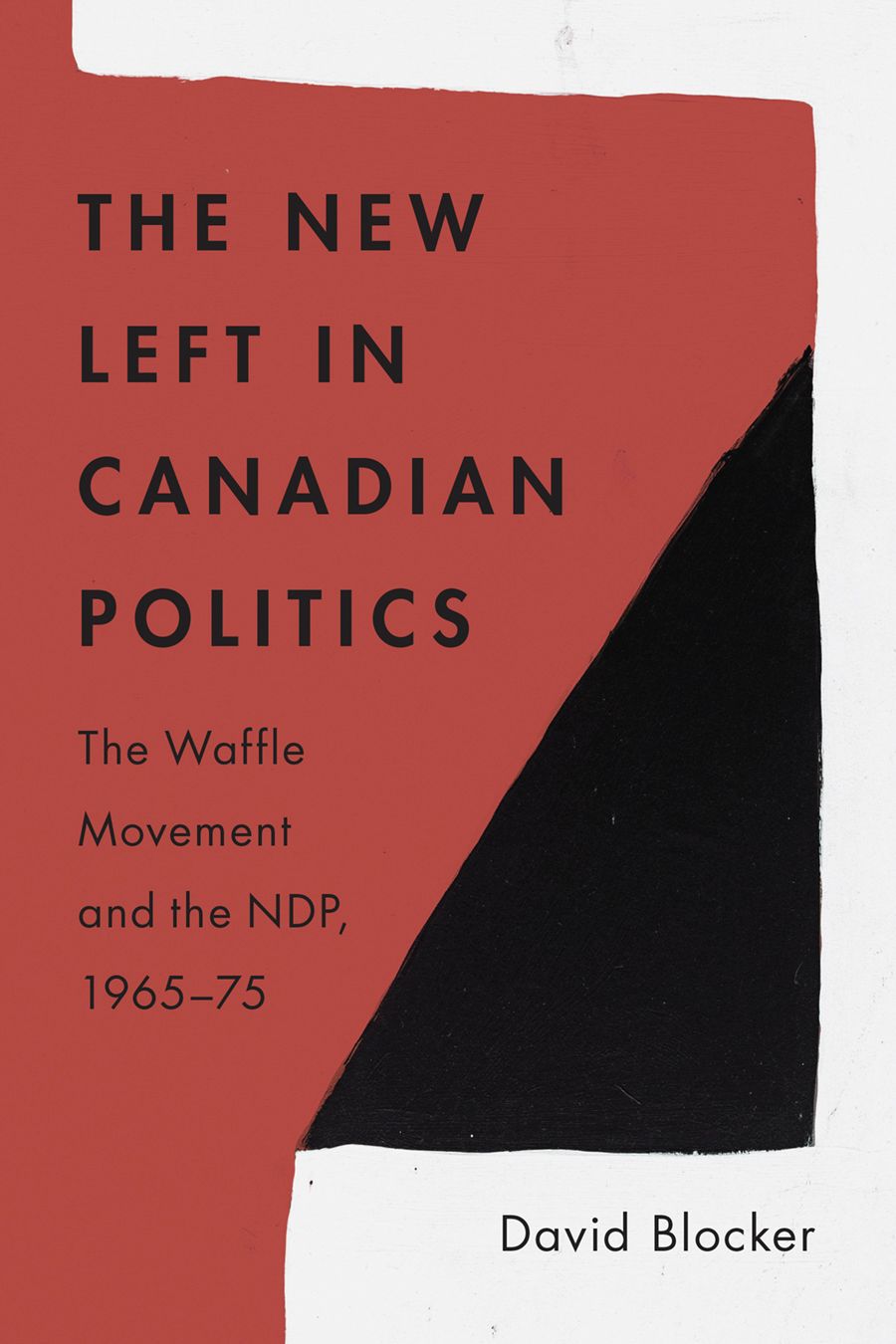
Coincidentally, a new book on the Waffle just came out on the same month that Lewis won the leadership, courtesy of UBC Press: The New Left in Canadian Politics: The Waffle Movement and the NDP, 1965-75 by David Blocker, a London, ON-based professor.
I am an aging baby boomer who is old enough to remember the rise of a progressive Canadian nationalism from the late 60s onward where the Waffle in its short life played a central role. Its focus was almost entirely economic but there was also a significant cultural side in the sudden explosion of creativity in books, music, theatre and arts in the country.
Blocker emphasizes how the Waffle was primarily a younger generational response of young New Leftists coming out of universities and the peace movement for greater democracy at the grassroots. All institutions whether they be government, corporate or political were perceived as bureaucratic, authoritarian and requiring major reform.
The 1969 Waffle manifesto put into words already existing concerns in Canada about the level of American domination of resources and manufacturing and how decisions about the economy were being made outside the country.
A key participant was the University of Toronto political economist Mel Watkins who had authored a federal task 1968 report, the “Foreign Ownership and the Structure of Canadian Industry.”
The “Watkins Report” garnered a lot of public attention and support in certain quarters (such as the federal NDP) because of its recommendations for stronger regulation of foreign investment and the establishment of a Canada Development Corporation to facilitate greater Canadian ownership in the economy. It was a mild report Watkins later admitted but it was not enough to convince the ruling Liberals under Lester Peason in the later 1960s to adopt it. (That reluctance later changed after Pierre Trudeau took the helm of the Liberal party).
Watkins himself in the later 1960s was heading into a more radical direction, after coming to the conclusion that Canadian business with its US ties could never be counted to fully stand up for Canada.
The Waffle Manifesto advocated that large sections of the economy including finance and resources be nationalized in order that the federal government could make the necessary changes and adjustments to enhance Canadian sovereignty.
“The Canadian corporate elite has opted for a junior partnership with these American enterprises. Canada has been reduced to a resource base and consumer market within the American Empire,” the manifesto stated.
Although the manifesto lost by a vote of 499 to 268 in the 1969 NDP federal convention in Winnipeg, a new movement had succeeded in having some of its resolutions passed, a few of their spokespersons elected to party positions and the garnering of a lot of media attention, says Blocker.
My first journalistic assignment at a student newspaper, Pro Tem, on the Glendon campus of York University was to interview Waffle co-founder James Laxer, then his late 20s. A little overweight and wearing a large moustache at the time, he exuded the self confidence that was typical of my generation.
As Blocker writes, Laxer was a Queens University graduate student in history when he began conceiving with a few other fellow students some of the ideas which ended up in the Waffle Manifesto including a then controversial proposal that Quebec had the right to determine its future within the Canadian Confederation.
Laxer was a superb organizer at the Waffle. He took a small faction in the NDP with a modest mailing list in May 1970 of 1,300 people across nine provinces and made it a major force within the party.
What really put the Waffle in the public spotlight was a polarized multi-ballot 1971 federal NDP leadership contest where James Laxer managed to come second as the main challenger facing the ultimate winner David Lewis — despite the presence of other party stars like Broadbent and John Harney who were also running for the top party job.
A powerful figure in the NDP, a founder of the party in 1961 and Avi Lewis’s grandfather, David Lewis was unrepentant in his loathing of the Waffle.
Blocker says that his son Stephen Lewis initially flirted with adding his name to the list of supporters for the Waffle manifesto, but then pulled back so as not to antagonize his father.
The argument against Waffle from its detractors including the Lewis clan was that it was acting like a separate party in an established party like the NDP, in making pronouncements and staking out a unique political identity. There was some truth in this assertion.
The Waffle did not have a formal membership of its own but an internal publication circulated amidst a network of activists who caucused regularly on their own time.
But for Waffle, which came out of the anti-bureaucratic New Left, its activities represented signs of healthy debate in a traditionally top-down political party.
In the interest of party unity some NDP members pushed for a compromise where the Waffle would have an affiliated status with the NDP. Both sides on the Waffle good or bad debate were not in the mood for compromise, says Blocker.
One example of the overheated rhetoric from labour was how Bob Mackenzie, a senior Steelworker and a future NDP Ontario provincial politician raised the parallel of UK prime minister Neville Chamberlain attempting to appease Adolf Hitler and his Nazi regime in Germany to stem the tide towards war in 1939.
The Canadian private sector union leaders in US based unions such as the United Auto Workers and the United Steelworkers were on a warpath to expel the Waffle.
Blocker writes about the friction within the UAW in Canada between an older leadership and restless younger workers – the latter frustrated that their union was “timid” when it came to negotiating working conditions. The Waffle was starting to make inroads in those dissident ranks.
For David Lewis the Waffle represented a new manifestation of the Communist Party which he had battled within the labour movement during the height of the Cold War after World War II.
The presence of a former Communist and James Laxer’s father, Robert Laxer in the Waffle only seemed to reinforce elements of paranoia in the elder Lewis.
Stephen Lewis himself delivered a passionate speech against the Waffle in March 1972 at the provincial council of the Ontario NDP which he started leading two years earlier. In the spring of 1972, the decision was made to expel the Waffle by the ONDP.
Ultimately, this set the stage for the demise of the Waffle in the party in Saskatchewan and BC where it was also active.
What specially made the Waffle vulnerable inside the NDP was its sympathy to the growth of a small but energetic independent Canadian union movement.
The selling point for Canadian based unions was that the dues money stayed in this country rather than be siphoned south of the border to the head office of international unions.
Sadly, if the Waffle had managed to survive, the matter of the clout of international American dominated unions would eventually become less relevant. Growing nationalism and negotiating differences with the Detroit union leadership caused the Canadian section of the United Auto Workers to separate from the UAW in 1985 to form a separate Canadian Auto Workers union under Bob White.
Seeing how the Waffle had helped to make Canadian economic nationalism popular in the country by 1970, the Liberals under Pierre Trudeau started to adopt nationalistic measures such as a Foreign Investment Review Agency, the Canadian Development Corporation and a new government run oil company (Petro Canada)
Eventually, the forces in the business community pushing for free trade with the US and other countries became ultimately successful in the late 1980s following the coming to power of Brian Mulroney.
All of the Liberal measures – FIRA, CDC and Petro-Canada ended up on the chopping block.
So, here we are in 2026. Canadian nationalists such as Maude Barlow and Rick Salutin during the free trade debate in the 1980s had warned about the dangers of our country becoming too integrated with the US. But that is the situation today as US president Donald Trump is threatening the loss of Canadian jobs in the steel and auto sector with punishing new tariffs despite an already existing free trade agreement with the US and Mexico.
The Waffle manifesto was originally silent on feminism but the movement subsequently did have a lasting impact on the NDP in terms of pushing for a greater role for women in senior party roles.
One former Waffler Jackie Larkin told me in an interview that feminists like her outgrew the Waffle as they started building a Canadian feminist movement in areas such as abortion and reproductive rights over the course of the 1970s and beyond.
Sadly, the Waffle had nothing to say about Indigenous rights which was starting to come into its own in the 1970s after the federal government of Pierre Trudeau tried and failed to take away their treaty rights. After the Waffle’s expulsion, Mel Watkins ended up advising the Dene Nation in the NWT during the Mackenzie Valley Pipeline inquiry.
Some of the major Wafflers stayed in the NDP including both Watkins and Laxer. Blocker argues that the party policy wise did not stray post Waffle from standard NDP policies at the federal or provincial level.
After reading his book I posed this question to Alvin Finkel, who formerly edited Canadian Dimension magazine in Winnipeg in the early 1970s and was a Waffler himself.
Today, an emeritus professor of history at Athabasca University in Edmonton, he argues that the NDP mainstream had less to offer policy-wise to Canadians following the disappearance of the Waffle.
“In the 1960s and early 1970s, the mainstream NDP narrowly focused on pressuring the Liberals to expand social spending. They were shocked when the Liberals gradually joined the Conservatives in espousing neoliberal ideas of containing social spending to permit corporations to focus on economic growth,” says Finkel.
He says that post Waffle, the NDP provided no alternative to neo-liberalism.
“They Waffle had always had a stronger sense than the NDP mainstream of the ephemeral quality of post (World War II) concessions of capital to labour. The NDP could have provided a populist socialist set of alternatives to neo-liberalism. But the Waffle was no longer prominent in the party,” he adds.
Regarding parallels with the new NDP leadership of Avi Lewis, it can be tricky to draw too many comparisons with the past. There are some elements of the old Waffle in the opposition to Mark Carney’s new militarism AND the US Israel war on Iran PLUS the application of public ownership to address inequities in the market economy. Also, climate change looms larger today as an issue for a party that is unfortunately split on proposed bans of new fossil fuel projects by Lewis himself.
Still, everyone interested in the history of the NDP and the Canadian left should read David Blocker’s very readable account of the Waffle which is based on his PhD thesis.
This article first appeared in rabble.ca.