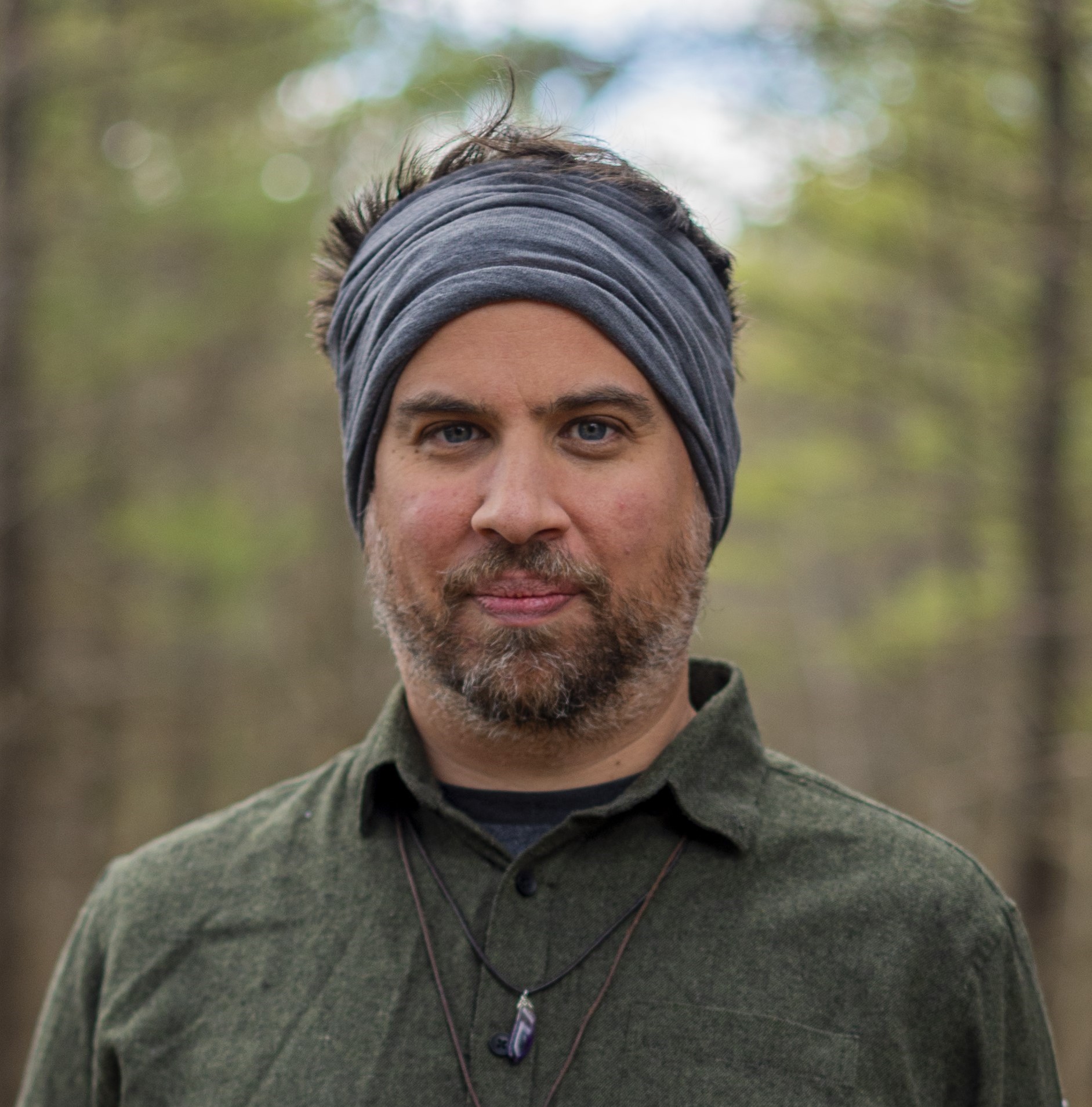
Photo by Jon Geiger.
In an age when a provincial premier dismisses the value of studying the humanities, newspapers no longer carry book review sections, Canadian publishers struggle with financial pressures and AI continues to threaten what makes us human, there is a Canadian author who today believes that “fiction can change the world.”
Naïve? He says that he is not. “I am incredibly passionate about book fiction and literature and its role in the world,” says Aaron Kreuter, a Toronto based author of short stories, poetry and a first novel.
By day he is a 40-year-old professor at Trent University teaching creative writing, Jewish fiction, world literature and eco-fiction among other areas.
Kreuter’s literary career has really taken off. His 2022 poetry Shifting Baseline Syndrome was the finalist or short listed for three separate awards — the Governor General’s Literary Award, the League of Canadian Poets’ Ray Souster award and the Vine Award in Jewish Literature.
Ruby, a 21-year-old woman, is the central character in his poignant 2025 novel about a Jewish summer camp, Lake Burntshore. The highlight of her existence every year while going to university in Toronto is to continue to work summers as a paid camp counsellor up north overseeing a bunch of younger kids in a cabin.
The major twist in the novel is that Ruby is a committed anti-Zionist Jew (rather like the author Kreuter himself) and she has to come to terms with the last-minute decision by the Lake Burntshore owners to hire several Israeli soldiers to function as camp counselors due to a staff shortage.
Invariably she falls in love with Etai, one of the IDF soldier-counselors who stands out from the rest of his comrades as a conscientious objector refusing to serve in uniform in the occupied Palestinian territory.
A second and somewhat ironical settler colonial subplot pops up Lake Burntshore where the summer camp owner schemes to purchase surrounding Crown land – which is also claimed by a local First Nation as its rightful property. This threatens to ruin a decent relationship with the camp’s neighbour.
Kreuter says he deliberately set the novel in 2013 partially because that was the last major summer for the Idle No More Indigenous activist movement.
“A lot of the book comes from personal experience and experiences of my partner and my family,” Kreuter says.
In conducting research on Jewish summer camps for the book and afterward for a published article in the online publication, Mondoweiss, Kreuter discovered that there are approximately 1,500 Israel soldiers or ex-soldiers working as counselors. Some of them are coming from Gaza and they are working in about 155 Jewish summer camps across North America, serving as “ideographical ambassadors for Israel.”
“There is a whole subgenre in Jewish studies on Jewish camp studies. The Jewish summer camp is the place where Jewish identity is born. There is a lot of writing on how Zionist indoctrination works,” he continues.
The issue of Israel soldiers working probably since the 1970s in Canadian and American Jewish summer camps has taken on greater scrutiny and urgency since Oct. 7.
It follows revelations by reputable human rights organizations of genocide, forced starvation, withholding of medical supplies and health care directed against Palestinian civilians in Gaza by IDF.
Coupled with this, are the reports of the IDF working side saddle with the extremist Jewish settlers seeking to expel Palestinians from their homes and farms in the occupied West Bank.
Kreuter says there is a lot of money and institutional behind this ideological program in the Jewish summer camps. “Camp directors go to Israel; it is all about the soldiers.”
“It is very disturbing to me the way these camps welcome in soldiers, some of them are literally war criminals from the killing fields of Gaza…It shows what anti-Zionist Jews are up against,” he says.
Decades ago, US literary critic Irving Howe pronounced the death of the serious Jewish novel following the publication of major books by the likes of Saul Bellow, Philip Roth and Bernard Malmud. What was left to write about after Jews had made the transition in North America from the Yiddish speaking immigrant living in New York’s Lower East (or Toronto’s Kensington Market) for that matter to the fully assimilated secular Jew living like their gentile suburbanite neighbours.
Kreuter counters that crisis of moral failure and intense schisms inside the diasporic Jewish communities including Canada with regards to Israel and Palestine makes for a rich subject of exploration. He talks about an indifference towards the deaths of Palestinians by Israel and a lack of appreciation of their humanity. “The dominance and the strength of the Zionist narrative is daunting.”
“I really see the need for Jewish fiction that wants to remain relevant, ethical and grounded in the real world that really looks back at the Jewish community and how we allowed this violent ethno-nationalistic ideology, to take over our identity. I am talking mostly about Jewish fiction from the diaspora, mostly from Toronto. In many ways, Israeli fiction is its own thing entirely. It has been much more critical of the Zionist project than North American Jewish fiction.”
One of his current projects is putting together a collection of anti-Zionist Jewish fiction.
Coming out more recently as an anti-Zionist Jewish writer has made him persona no grata at the Canadian Jewish News which has not reviewed Lake Burntshore. On the other hand, the same newspaper did review his 2018 short story collection, You and Me Belonging, when he was largely unknown.
Word of mouth is the primary means the novel ends up getting purchased by anti-Zionist or dissenting Jews coming out of the woodwork he explains. “I was at a family event and someone came up to me and quietly said to me, ‘you know I have read your work and really liked it. My partner warned me not to say it too loudly here.’”
Kreuter counts among his influences, the US novelist Philip Roth who criticized the best-selling 1958 Zionist potboiler novel Exodus by Leon Uris and was the author of more literary bell weather works on Israel such as Operation Shylock and The Counterlife.
Roth, he argues, has proved to be among the exceptions to the rule as many Jewish writers in the past have either allowed Zionism to be the dominant “hegemonic narrative” or facilitated this trend through “benight neglect,” of the Palestinian issue. This is the subject of his 2023 non-fiction book, Leaving Other People Alone: Diaspora, Zionism and Palestine in Contemporary Jewish Fiction.
Here at home the Montreal born writer Mordecai Richler is also a major influence for Kreuter.
He points to Richler’s non-fiction memoir, This Year in Jerusalem where the author ruminated over his left-wing Zionist family roots. “There are different opinions about the book but at the end, [Richler] comes right out and says if he had been born a Palestinian child, he would definitely thrown rocks at the Israeli tanks.”
“I love Richler; I love his fiction; His novel The Apprenticeship of Duddy Kravitz is a satire of the Canadian settler colonial mindset,” he says.
He says that Richler “excoriates the Canadian Jewish desire to assimilate and become like a wealthy elite, etc.”
“Richler has this fearless ability to talk back to power, to satirize and critique without fear of repercussions He and I also have the same birthday,” Kreuter notes.
Kreuter spent much of his formative years growing up in the Jewish community of Thornhill, just north of Toronto which is notoriously conservative in its political representation and orientation.
Thornhill is also where many of the stories are set in his wonderful collection, Rubble Children. “I wasn’t aware of [Thornhill’s Zionist political culture] as a teenager or young person growing up but I definitely am aware of it now.”
In Israel, people including soldiers know and have heard of Thornhill in Canada, he reveals. “It feels like a safe place to visit.”
This article was originally published in the spring 2026 issue of the UJPO News.